
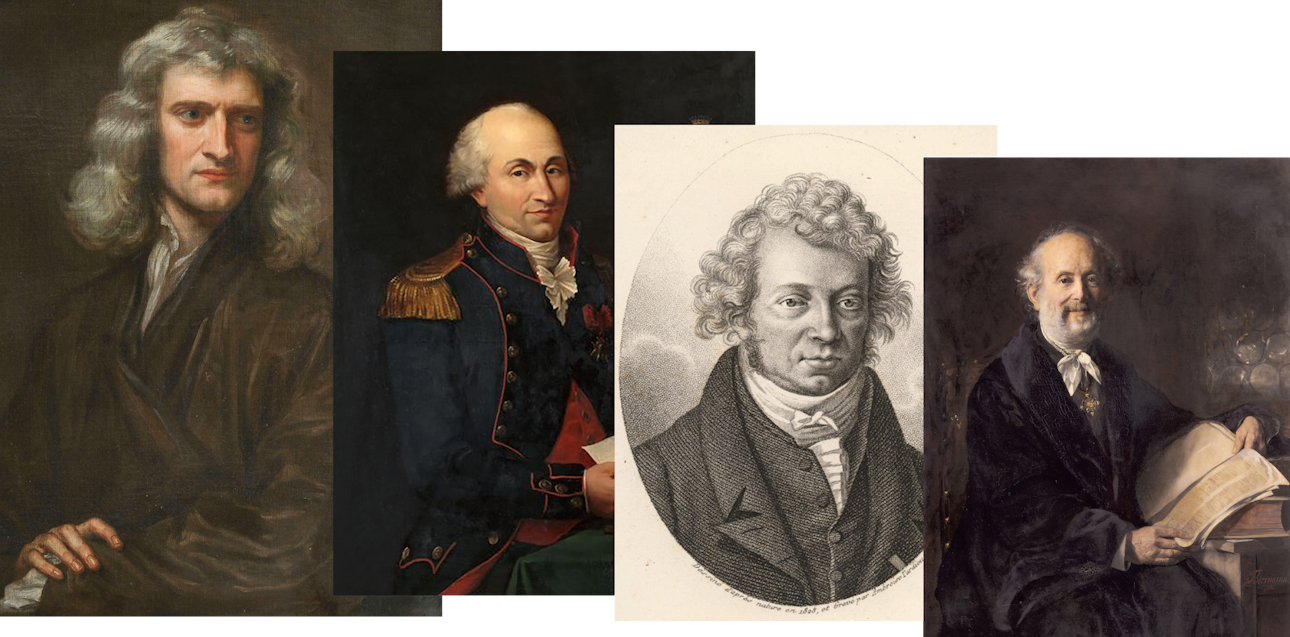
From Newton to Coulomb, Ampère to Weber

First was Newton. He published his "Philosophiæ Naturalis Principia Mathematica" in 1687. This established a law of gravity for the first time.
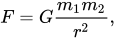
Newton's Law

Next came Coulomb. He established a very similar looking equation for his law of force between two charges.
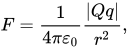
Newton's Law

Then came Ampère. He took the static force law Coulomb had developed and by experimentation added velocity terms to it. This lead to Ampère's law.

Ampère's Law

Weber then took Ampère's work and advanced, using his experimentation, it to include accelerations.

Weber's Law

This is how electrodynamics was born.

Weber's Predictions

Any good theory, especially if it is derived from experiment, can be tested from it's predictions. Here are the predictions from Weber:

1846 - Weber's Law
  • Weber's Law is a general solution to two charges interacting without frames of reference
  • Weber made the connection between electromagnetism and optics much earlier than Maxwell
  • Weber introduced the concept of 'C', the speed of light
1856 - Speed of Light
  • Weber was the first person to measure the speed of light
  • He measured it as 3 x 10^8 m/s
  • The speed of light is represented as the speed of the electrodynamic force
1857 - Transmission
  • Weber and Kirchhoff obtained the telegraph equation
  • This predicted the transmission of signals in wires
  • This introduced the wave function that Maxwell obtained much later
1870-1880 - Atomic Model
  • Weber's planetary model for the atom predicted a dense positive core with orbiting electrons 
  • No weak force is required to keep the nucleus intact, just the electrodynamic force
  • This preceded the discovery of the electron (1897), Balmer’s spectral series (1897)  Rutherford’s scattering experiments (1911) and Bohr’s model (1913)